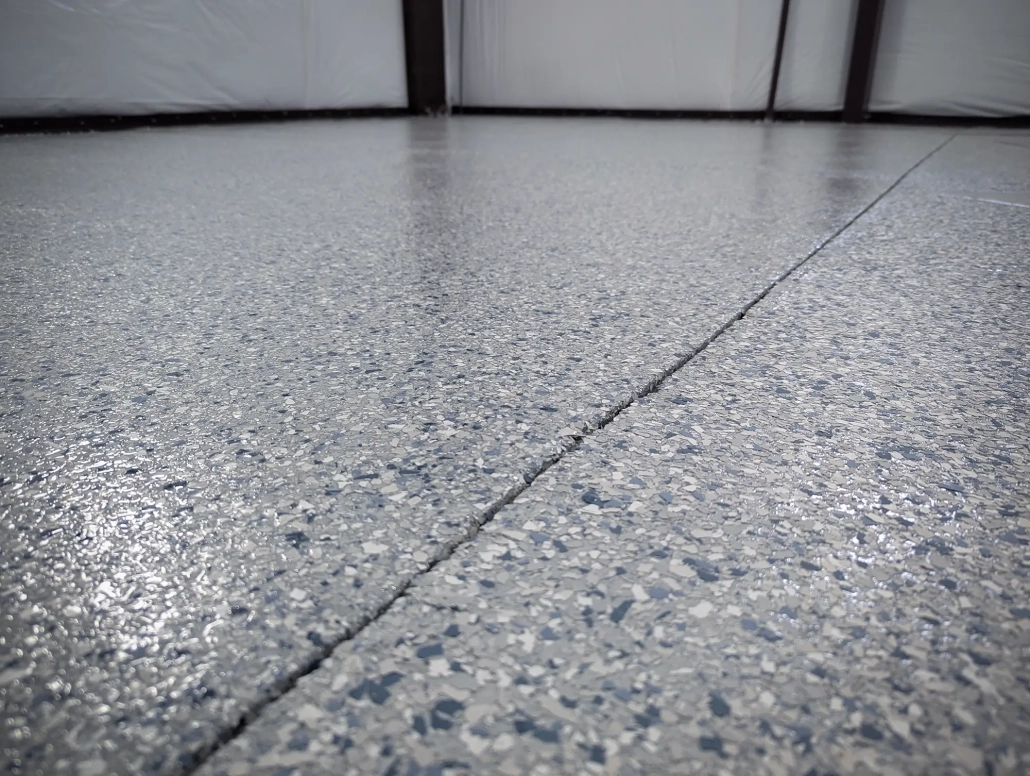
For years, epoxy garage floors were the gold standard for homeowners looking to upgrade their space. But in Colorado, where the sun is more intense and the temperature can swing 40 degrees in a single afternoon, epoxy often fails to keep up.
If you are tired of looking at peeling, yellowed, or cracked garage concrete, it’s time to look at the next generation of flooring: Polyaspartic Floor Coatings.
The Problem: Why Traditional Epoxy Fails in Colorado
While epoxy is a decent indoor solution for climate-controlled environments, it struggles with the unique challenges of the Rocky Mountain region:
- Brittle in the Cold: Epoxy is a rigid material. When Colorado’s “Freeze-Thaw” cycle causes your concrete slab to expand and contract, epoxy doesn’t move with it. The result? Hairline cracks and peeling.
- UV Yellowing: At 5,280+ feet, our UV exposure is significantly higher. Standard epoxy lacks UV stability, meaning your beautiful floor can turn a sickly shade of amber within a single summer.
- Hot-Tire Pick-Up: Ever seen a garage floor where the coating literally peeled up under the car tires? That’s “hot-tire pick-up,” a common epoxy failure when tires heat up on I-25 and then park on a cool floor.
Local Insight: Most “Big Box Store” DIY epoxy kits are designed for sea-level climates with stable temperatures. They aren’t built for the Colorado elements.
The Solution: Why Polyaspartic is the “Colorado Gold Standard”
At Colorado Custom Garages, we’ve moved away from traditional epoxy in favor of high-performance Polyaspartic coatings. Here is why it’s the superior choice for your home:
- 1-Day Installation & Fast Cure
Epoxy can take 3 to 5 days to fully cure before you can drive on it. Our Polyaspartic system is installed in one day and is usually ready for foot traffic in just a few hours. - Extreme Temperature Flexibility
Polyaspartic is “elastomeric,” meaning it has a slight flexibility. When your concrete shifts during a Denver winter, the coating stretches instead of snapping. - Resistance to Mag-Chloride and Road Salt
Colorado roads are treated with aggressive chemicals like magnesium chloride. Polyaspartic creates a non-porous shield that prevents these salts from eating away at your concrete slab.
Polyaspartic vs. Epoxy: At a Glance
- Feature
- Install Time
- Cure Time
- UV Resistance
- Durability
- Flexibility
- Adhesion
- Traditional Epoxy
- 2–3 Days
- 5–7 Days
- Poor (Yellows)
- Brittle/Chops
- Low
- Good
- Polyaspartic Coating
- 1 Day
- 24 Hours
- Excellent (Stable)
- Impact Resistant
- High
- Superior (Mechanical Bond)
Colorado-Specific Durability: Built for the Front Range
Whether you are in Denver, Fort Collins, or Colorado Springs, your garage is more than just a place to park—it’s where you store your skis, mountain bikes, and camping gear. You need a floor that can handle:
- Heavy Gear: Dropping a ski or a tool won’t chip the surface.
- Snow Melt: Slush and salt run-off won’t penetrate the finish.
- High Altitude Sun: Your floor will stay the same color it was the day we installed it.
Ready to Upgrade Your Garage?
Don’t settle for a floor that wasn’t built for our climate. Experience the durability, beauty, and speed of a professional Polyaspartic floor coating from the local experts.